

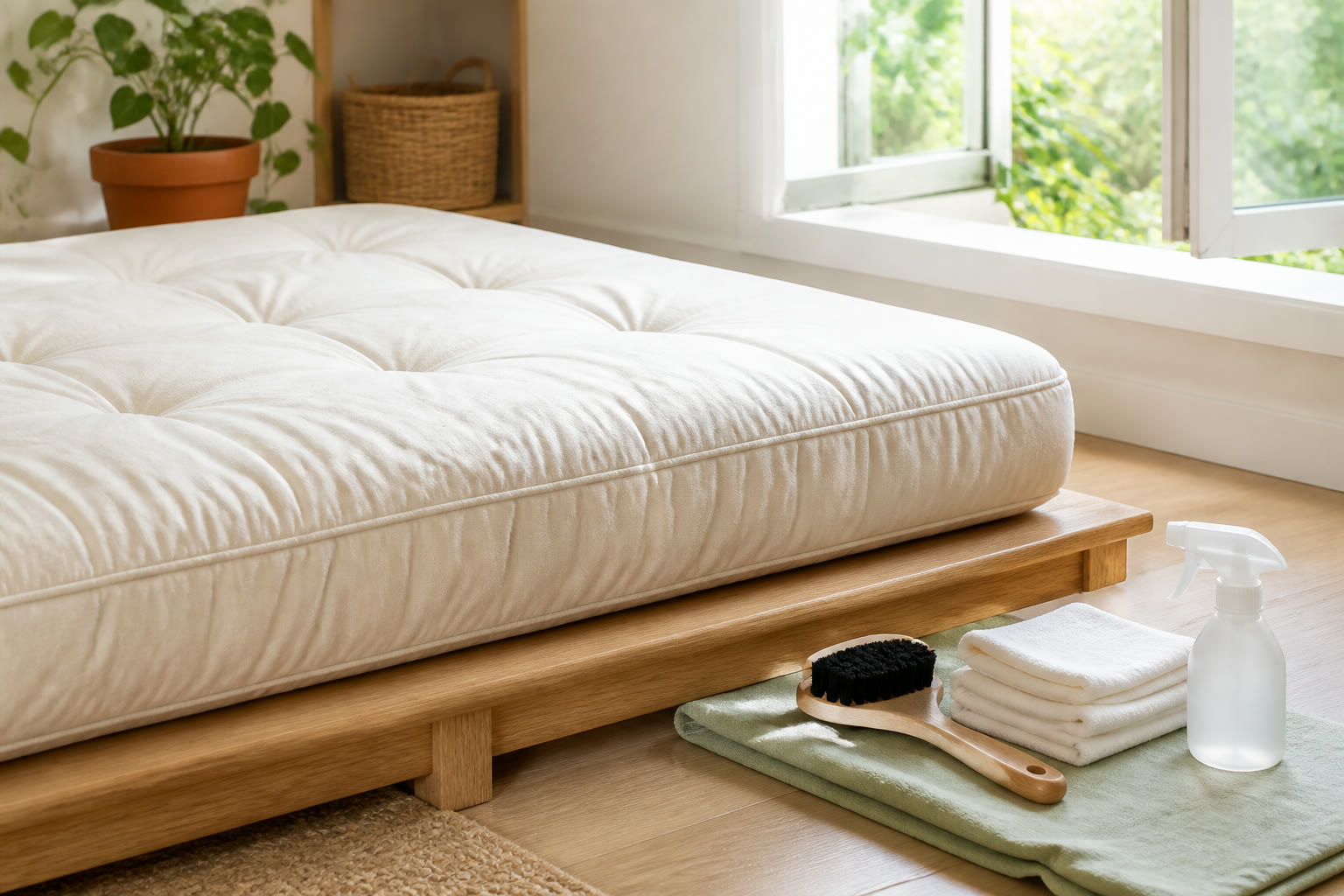
Key takeaways
What to know first
- ✓Remove the source instead of masking it with fragrance.
- ✓Ventilate both sides and the surface below.
- ✓Wash removable covers according to their label.
- ✓Persistent mustiness or visible mold requires caution.
The complete answer
How to get a smell out of a futon: explained
Remove a futon smell by identifying whether it comes from spills, body oils, pets, smoke or dampness; then clean the cover, vacuum and air the mattress, and use only label-safe low-moisture treatment. A persistent musty odor can indicate hidden moisture or mold. That conclusion is most useful when it is connected to the room, sleeper and frequency of use rather than treated as a universal rule. The intended audience for this guide is owners dealing with stale, musty, pet or spill odors, so the recommendations below emphasize practical decisions that can be checked before money is spent or a cleaning method is used.
For how to get a smell out of a futon, construction changes the answer: a framed sofa bed, click-clack converter, folding chair, floor futon and separate mattress do not behave alike. Apply the first two checks—odor source and underside moisture—to the exact format instead of letting one shared size label conceal those differences.
A reliable answer to “how to get a smell out of a futon” separates measurable evidence from preference. In this guide, cover cleanliness, room humidity, visible spotting can be checked, while comfort and visual taste remain individual. That distinction keeps the recommendation useful for owners dealing with stale, musty, pet or spill odors without turning a subjective response into a guarantee.
Decision framework
Six checks that matter
Use the following checks as a short specification audit. They turn the primary question—how to get a smell out of a futon—into details that can be measured, compared or confirmed. Write the answers down for each shortlisted product or for the futon already in your home; missing information is itself a useful warning.
For the how to get a smell out of a futon decision, document “odor source” for the exact futon and intended user; it is check 1 because a broad category assumption cannot establish this fact.
For the how to get a smell out of a futon decision, document “underside moisture” for the exact futon and intended user; it is check 2 because a broad category assumption cannot establish this fact.
For the how to get a smell out of a futon decision, document “cover cleanliness” for the exact futon and intended user; it is check 3 because a broad category assumption cannot establish this fact.
For the how to get a smell out of a futon decision, document “room humidity” for the exact futon and intended user; it is check 4 because a broad category assumption cannot establish this fact.
For the how to get a smell out of a futon decision, document “visible spotting” for the exact futon and intended user; it is check 5 because a broad category assumption cannot establish this fact.
For the how to get a smell out of a futon decision, document “drying conditions” for the exact futon and intended user; it is check 6 because a broad category assumption cannot establish this fact.
At-a-glance comparison
A practical comparison table
The table below condenses the most important options for owners dealing with stale, musty, pet or spill odors. Use it to narrow the field, then verify live dimensions and instructions before acting. A concise table is useful for comparison, but it cannot account for every body type, room or product variation.
| Option or situation | What it means | Best next check |
|---|---|---|
| Stale fabric | Vacuum, wash cover and ventilate | Rotate and air regularly |
| Food or drink | Treat the source stain | Avoid soaking filling |
| Pet odor | Use material-safe enzymatic care if approved | Patch test first |
| Musty odor | Find moisture source and inspect for mold | Replace if contamination is extensive |
Step by step
How to make the decision safely
Use the how to get a smell out of a futon steps in the order shown. The sequence for owners dealing with stale, musty, pet or spill odors moves from “Strip the bed and inspect both sides in bright light.” to “Reassess only after the futon is completely dry.”, preventing appearance or a convenient shortcut from outranking the actual requirement.
- 01
Strip the bed and inspect both sides in bright light.
At step 1 of how to get a smell out of a futon, record the result of “strip the bed and inspect both sides in bright light.” and compare it with the intended use. If the relevant specification or instruction is unclear, confirm it with the maker or current listing before moving to step 2.
- 02
Vacuum and ventilate the mattress and room.
At step 2 of how to get a smell out of a futon, record the result of “vacuum and ventilate the mattress and room.” and compare it with the intended use. If the relevant specification or instruction is unclear, confirm it with the maker or current listing before moving to step 3.
- 03
Wash or spot-clean the cover as directed.
At step 3 of how to get a smell out of a futon, record the result of “wash or spot-clean the cover as directed.” and compare it with the intended use. If the relevant specification or instruction is unclear, confirm it with the maker or current listing before moving to step 4.
- 04
Use a label-safe deodorizing method sparingly.
At step 4 of how to get a smell out of a futon, record the result of “use a label-safe deodorizing method sparingly.” and compare it with the intended use. If the relevant specification or instruction is unclear, confirm it with the maker or current listing before moving to step 5.
- 05
Reassess only after the futon is completely dry.
At step 5 of how to get a smell out of a futon, record the result of “reassess only after the futon is completely dry.” and compare it with the intended use. If the relevant specification or instruction is unclear, confirm it with the maker or current listing before moving to step 6.
Avoidable problems
Common mistakes to avoid
For owners dealing with stale, musty, pet or spill odors, the most avoidable how to get a smell out of a futon problems come from skipping a basic check. The four warnings below connect directly to odor source, underside moisture, cover cleanliness; reconsider the plan whenever the real room, product or care label contradicts general advice.
“Spraying perfume over the odor” can distort the answer to how to get a smell out of a futon. Return to the relevant measurement, material or written instruction, then choose the option that creates the fewest compromises for owners dealing with stale, musty, pet or spill odors.
“Ignoring the floor underneath” can distort the answer to how to get a smell out of a futon. Return to the relevant measurement, material or written instruction, then choose the option that creates the fewest compromises for owners dealing with stale, musty, pet or spill odors.
“Folding during drying” can distort the answer to how to get a smell out of a futon. Return to the relevant measurement, material or written instruction, then choose the option that creates the fewest compromises for owners dealing with stale, musty, pet or spill odors.
“Sleeping on suspected mold” can distort the answer to how to get a smell out of a futon. Return to the relevant measurement, material or written instruction, then choose the option that creates the fewest compromises for owners dealing with stale, musty, pet or spill odors.
Real-world fit
How this advice changes by household
The household answer to how to get a smell out of a futon changes with frequency and user. For owners dealing with stale, musty, pet or spill odors, contrast occasional use with the repeated routine implied by “strip the bed and inspect both sides in bright light.”. Mobility, body size, sleep position, climate and storage can all shift the conclusion summarized at the top of this page.
Room context for how to get a smell out of a futon centers on odor source and underside moisture. Keep a clear route, assign storage for loose bedding and adapt the routine to the format: floor products need underside ventilation, while framed mechanisms need operating clearance and adherence to stated capacity.
Keep the how to get a smell out of a futon decision reversible when evidence is incomplete. Retain packaging until inspection, prefer clear return terms and avoid altering materials before the setup satisfies “drying conditions”. Specifications cannot guarantee comfort, but this article's checks remove preventable surprises.
Quick answers
How to Get a Smell Out of a Futon: FAQs
Does baking soda remove futon smells?+
It may absorb mild surface odor when used dry and vacuumed well, but it will not solve moisture or deep contamination.
How long should I air a futon?+
Until both sides and the room smell neutral and the filling is completely dry; damp conditions can require extended airflow.
Can sunlight help?+
Fresh air and indirect sun can help some materials, but check care guidance because strong sun may fade fabrics.
What does a musty smell mean?+
It often signals retained moisture and can indicate microbial growth, so inspect carefully before reuse.